India’s $200 Billion Export Opportunity Beyond US Market
By Donu••Business• 110 views
Advertisement
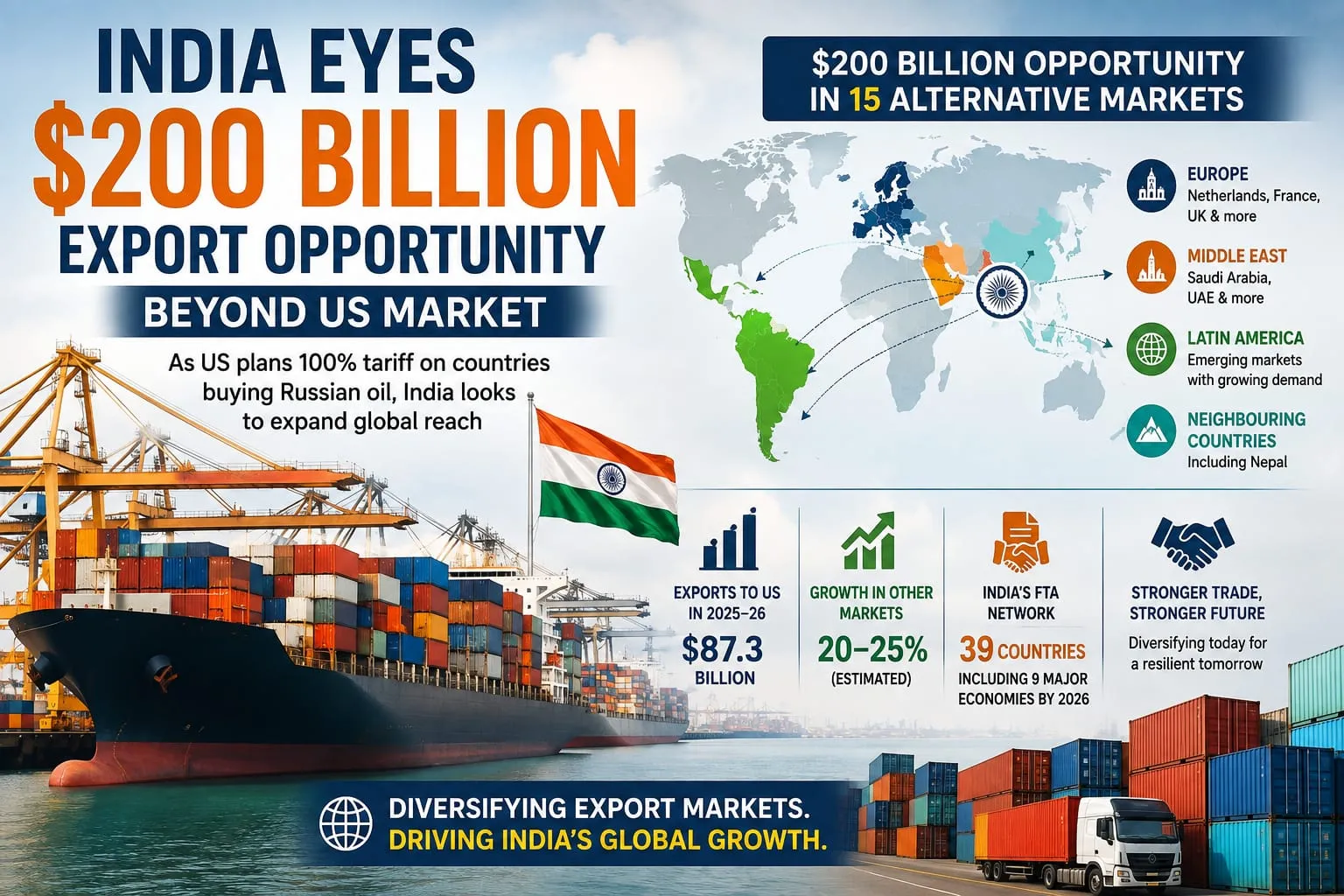
India Eyes $200 Billion Export Opportunity as US Tariff Threat Pushes Market Diversification
India Could Unlock $200 Billion Export Opportunity Beyond US Market
New Delhi: India could unlock an estimated $200 billion export opportunity across 15 alternative global markets if the United States imposes a proposed 100% tariff on imports from countries purchasing Russian oil.
The potential tariff could put pressure on Indian exports to the US, which were worth around $87.3 billion in 2025–26. However, the situation could also accelerate India's efforts to diversify its export destinations and expand its presence in faster-growing international markets.
Economists believe that reducing excessive dependence on any single market could help Indian exporters build a more resilient and geographically diversified global trade network.
15 Alternative Markets Could Offer Major Opportunities
Economist S.P. Sharma has highlighted several markets that could offer significant opportunities for Indian exporters, including the Netherlands, France, the United Kingdom, Latin America, Saudi Arabia, the UAE and Nepal.
These markets could become increasingly important as Indian businesses look for alternatives to the US market.
According to Sharma, exports to some of these alternative destinations could grow at 20–25%, compared with approximately 10–15% in the US market.
The faster growth rate suggests that Indian exporters could benefit from expanding their presence in economies where demand for Indian products is increasing.
US 100% Tariff Could Put Pressure on Indian Exporters
A proposed 100% US tariff on Indian goods could significantly increase the price of Indian products in the American market.
Higher import costs could make Indian goods less competitive, potentially affecting demand and putting pressure on exporters operating in sectors that rely heavily on the US market.
At the same time, American consumers and businesses could also face higher prices for imported products.
Economists have warned that excessive tariffs could ultimately hurt both economies and increase the possibility of a prolonged trade dispute.
S.P. Sharma has emphasized that India and the US should address trade-related differences through dialogue and negotiations to avoid unnecessary escalation.
India Looks Beyond the US to Expand Global Exports
The potential tariff threat comes at a time when India is already working to expand its international trade network.
India is pursuing Free Trade Agreements (FTAs) with several countries and trading blocs to improve market access for Indian businesses and create new opportunities for exporters.
Greater access to international markets could help Indian companies increase exports while reducing their dependence on the US.
The strategy could be particularly important for industries such as:
- Textiles and garments
- Pharmaceuticals
- Engineering goods
- Chemicals
- Electronics
- Automobiles and auto components
- Agricultural products
- Food processing
- Machinery and industrial products
Expanding into new markets could give these sectors additional opportunities to increase sales and establish stronger international supply chains.
Europe, Middle East and Latin America Could Gain Importance
India's export diversification strategy could increase the importance of markets across Europe, the Middle East, Latin America and neighbouring economies.
Countries such as the UAE and Saudi Arabia could provide opportunities in the Middle East, while European markets such as the Netherlands, France and the UK could offer additional demand for Indian manufactured and value-added products.
Latin America also represents a potentially important long-term market as Indian businesses seek to expand their global footprint.
Neighbouring countries such as Nepal could provide opportunities for Indian companies because of geographic proximity and existing commercial ties.
Export Diversification Could Strengthen India’s Global Trade Position
The possibility of higher US tariffs highlights the risks associated with relying too heavily on a single export market.
For India, expanding into multiple markets could help reduce exposure to trade-policy changes in any one country.
A diversified export strategy could also encourage Indian companies to develop products specifically suited to different international markets, improve quality standards and build stronger overseas distribution networks.
If the estimated $200 billion export opportunity across 15 alternative markets is successfully tapped, it could become an important source of future export growth.
A Challenge Could Become an Opportunity for Indian Exporters
The proposed US tariff presents a significant challenge for India's export sector. However, it could also accelerate a broader shift that is already underway: India's move towards export-market diversification.
Instead of relying heavily on traditional destinations, Indian businesses could increasingly target high-growth markets across Europe, the Middle East, Latin America and Asia.
The success of this strategy will depend on several factors, including competitive pricing, product quality, logistics, trade agreements, market access and the ability of Indian companies to understand local consumer demand.
What This Means for India’s Export Sector
The potential shift away from heavy dependence on the US could create both challenges and opportunities.
In the short term, exporters with significant exposure to the American market may face uncertainty if tariffs are imposed. In the longer term, however, greater diversification could make India's export sector more resilient.
The focus will likely be on finding new customers, entering emerging markets and using trade agreements to reduce barriers for Indian products.
Conclusion
India's potential $200 billion export opportunity across 15 alternative markets could become a major catalyst for export diversification.
While a proposed 100% US tariff could create significant challenges for Indian exporters, it may also encourage businesses to explore new markets and strengthen India's position in global trade.
With opportunities across Europe, the Middle East, Latin America and neighbouring economies, India has considerable scope to expand its export footprint.
The key will be turning this potential into actual export growth through stronger trade partnerships, competitive products, improved market access and continued efforts to diversify India's global trade network.
Frequently Asked Questions (FAQs)
1. What is India’s estimated export opportunity beyond the US market?
India could have an estimated $200 billion export opportunity across 15 alternative global markets, according to the assessment cited in the report.
2. Why is India looking at alternative export markets?
India is looking to diversify its export destinations and reduce excessive dependence on the US market. Expanding into multiple countries could make Indian exports more resilient to changes in tariffs and trade policies.
3. Which countries could offer opportunities for Indian exporters?
Potential markets highlighted include the Netherlands, France, the UK, Latin America, Saudi Arabia, the UAE and Nepal, along with other alternative destinations.
4. How much are India’s exports to the US worth?
India's exports to the US were valued at approximately $87.3 billion in 2025–26.
5. What could a 100% US tariff mean for Indian exporters?
A 100% tariff could make Indian goods more expensive in the US, potentially reducing their competitiveness and affecting demand. Indian exporters could face increased pressure if American buyers shift to alternative suppliers.
6. Could a US tariff affect American consumers?
Yes. Higher tariffs generally increase the cost of imported goods, meaning American importers, businesses and consumers could potentially face higher prices.
7. How can India reduce its dependence on the US export market?
India can reduce its dependence by expanding exports to Europe, the Middle East, Latin America, Asia and neighbouring countries, while also pursuing Free Trade Agreements and improving market access.
8. What role do Free Trade Agreements play in India’s export strategy?
Free Trade Agreements can reduce trade barriers, improve market access and make Indian products more competitive in partner countries. They are an important part of India's broader export diversification strategy.
9. Which sectors could benefit from new export markets?
Potentially important sectors include textiles, pharmaceuticals, engineering goods, chemicals, electronics, automobiles, agricultural products, food processing and machinery.
10. Could the US tariff threat become an opportunity for India?
It could. Although higher tariffs would create challenges for exporters with strong US exposure, they could also encourage Indian companies to enter new markets and build a more diversified and resilient export base.