Private Limited Company Registration in India: Complete Guide 2026
By Ashwasana••Business• 112 views
Advertisement
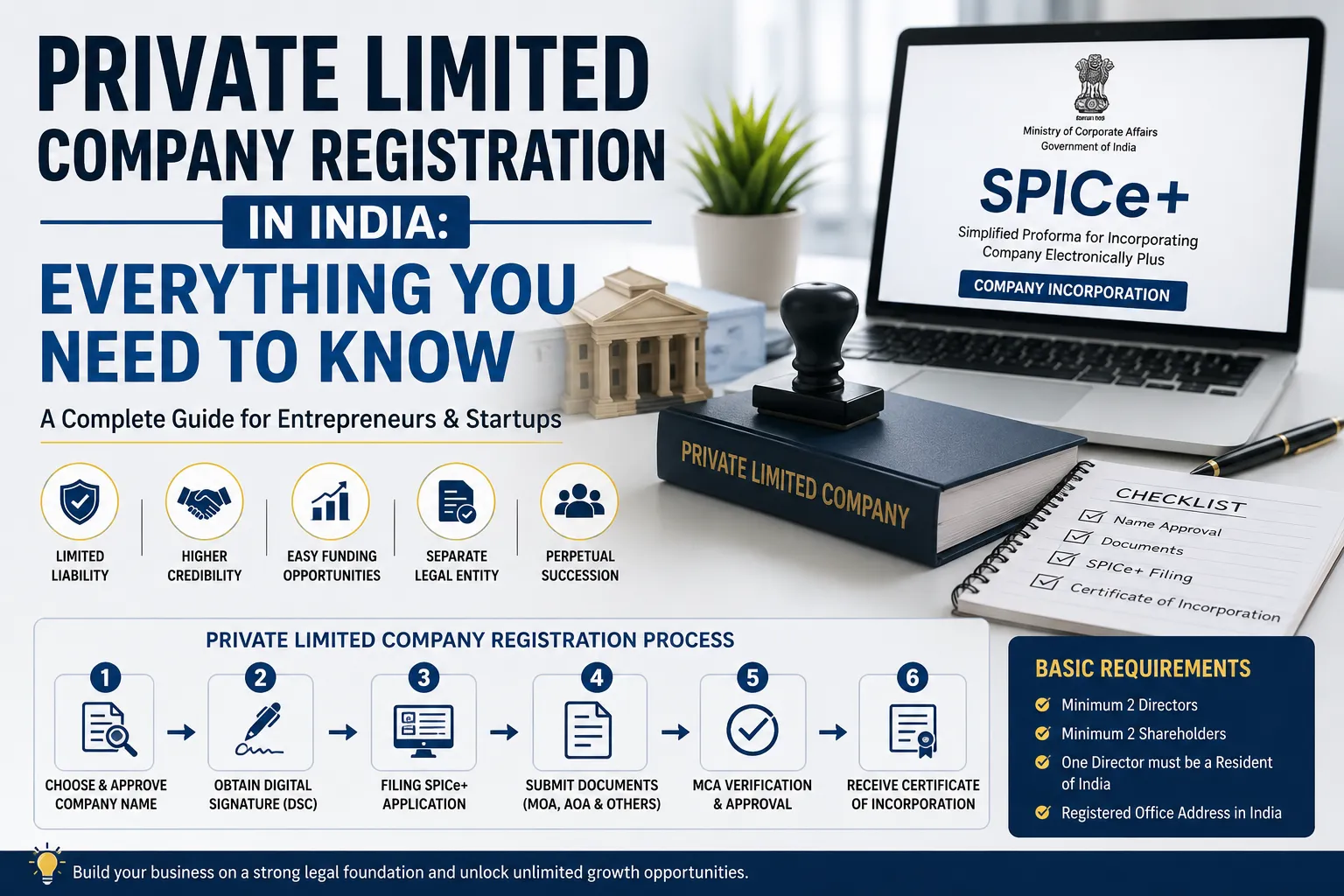
Private Limited Company Registration in India 2026 : Everything You Need to Know
Starting a business in India is easier when you choose the right legal structure from the beginning. For startups, entrepreneurs, professionals and growing businesses, Private Limited Company registration in India is one of the most popular options.
A Private Limited Company, commonly known as a Pvt Ltd company, provides a separate legal identity to the business and can offer advantages such as limited liability, better credibility, easier ownership structuring and potential access to investors.
If you are planning to start a business and want to know how to register a Private Limited Company in India, this guide explains the process, eligibility, documents, benefits, costs, timelines and important compliance requirements.
What Is a Private Limited Company?
A Private Limited Company is a company incorporated under the Companies Act, 2013. It has a separate legal identity from its shareholders, meaning the company can own assets, enter contracts, incur liabilities and conduct business in its own name.
For entrepreneurs searching for Pvt Ltd company registration in India, this structure is particularly suitable for startups and businesses that want to build a scalable and professionally structured organisation.
Under the Companies Act, a private company generally requires at least two directors, while a private company is formed by two or more persons. Every company must also have at least one director who satisfies the resident-director requirement under the law.
Why Choose a Private Limited Company?
There are several reasons why entrepreneurs choose Private Limited Company registration instead of operating as a sole proprietorship or partnership.
1. Limited Liability Protection
One of the biggest advantages of a private limited company is limited liability.
Generally, the shareholders' financial liability is limited to the amount they have agreed to contribute to the company. This can provide an important layer of protection between the company's liabilities and the personal assets of its shareholders.
2. Separate Legal Identity
A Private Limited Company has a legal identity separate from its owners.
This means the company can:
- Own property
- Open a business bank account
- Enter contracts
- Hire employees
- Borrow money
- Sue or be sued
- Conduct business independently of its shareholders
This separate identity is one of the major reasons businesses prefer company incorporation in India.
3. Better Business Credibility
Having a registered Pvt Ltd company can improve credibility with customers, vendors, banks and potential business partners.
For businesses working with large organisations or planning to expand, a formal corporate structure can make the business appear more established and professionally managed.
4. Easier Fundraising
Startups that plan to raise funds from angel investors, venture capital firms or other investors often prefer the Private Limited Company structure.
Shares can be issued or transferred according to applicable laws and the company's constitutional documents, making the structure more suitable for businesses planning future investment.
5. Perpetual Succession
A company has a continuing legal existence that is generally not dependent on the life or continued participation of an individual shareholder.
This can make a Private Limited Company more suitable for businesses that intend to operate and grow over the long term.
Who Can Register a Private Limited Company in India?
Entrepreneurs who meet the legal requirements can apply for Private Limited Company registration online through the Ministry of Corporate Affairs (MCA) system.
A typical private company requires:
- At least 2 directors
- At least 2 members/shareholders
- At least one director satisfying the resident-director requirement
- A registered office address in India
- A lawful business objective
- Required identity and address documents
- Digital signatures and other incorporation-related information
The Companies Act specifies a minimum of two directors for a private company.
The exact requirements can vary depending on whether the proposed shareholders or directors are Indian residents, foreign nationals, companies or other legal entities.
Documents Required for Private Limited Company Registration
One of the most important parts of Pvt Ltd company registration in India is preparing the correct documents.
Documents for Directors and Shareholders
Depending on the applicant's circumstances, commonly required documents include:
- PAN card
- Identity proof
- Address proof
- Passport-size photograph
- Residential address details
- Digital Signature Certificate (DSC)
- Director-related declarations and information
For foreign nationals or foreign entities, additional documentation and authentication requirements may apply.
Registered Office Documents
The company also needs a registered office address.
Commonly required documents may include:
- Proof of registered office address
- Recent utility bill
- Rent or lease agreement, where applicable
- No-objection certificate from the property owner, where applicable
- Ownership-related documents, depending on the circumstances
The MCA's SPICe+ FAQs list documents such as the Memorandum of Association, Articles of Association, office-address proof, utility bills, NOC and identity/address proofs among incorporation attachments, depending on the case.
How to Register a Private Limited Company in India
The Private Limited Company registration process is largely online through the Ministry of Corporate Affairs.
Step 1: Choose a Business Name
The first step is selecting a suitable company name.
Your proposed name should comply with applicable naming rules and should not create confusion with an existing company or trademark.
A good business name should be:
- Unique
- Easy to remember
- Relevant to the business
- Legally acceptable
- Suitable for future expansion
It is also wise to check trademark availability before finalising the name.
Step 2: Obtain Digital Signature Certificates
Company incorporation involves digitally signed documents.
Therefore, the proposed directors and relevant subscribers may need Digital Signature Certificates (DSCs) for filing the incorporation forms electronically.
Step 3: Apply Through SPICe+
The MCA uses the SPICe+ system for company incorporation.
SPICe+ is divided into two major parts:
SPICe+ Part A – primarily deals with name reservation.
SPICe+ Part B – contains the remaining information required for incorporation.
The MCA's instructions confirm that Part A can be submitted separately for name reservation or together with Part B for name reservation and incorporation.
This makes SPICe+ company registration an important part of the online incorporation process.
Step 4: Prepare MOA and AOA
Two important company documents are:
Memorandum of Association (MOA)
The MOA defines the company's basic objectives and scope.
It essentially establishes what the company is formed to do.
Articles of Association (AOA)
The AOA contains rules and regulations concerning the internal management of the company.
Together, the MOA and AOA form important constitutional documents of the company.
Step 5: Submit Linked Forms
The incorporation process can involve several linked forms and registrations.
The MCA's incorporation framework includes SPICe+ Part A and Part B along with linked forms such as e-MOA, e-AOA, INC-9 and AGILE-PRO-S, depending on the company's circumstances.
AGILE-PRO-S can also facilitate applications connected with services such as GSTIN, EPFO, ESIC, professional tax in applicable states, bank account opening and Shops & Establishments registration, subject to the applicable rules and requirements.
Step 6: MCA Verification
After the forms and required documents are submitted, the application is processed by the MCA.
If the Registrar of Companies identifies an issue, the applicant may need to provide clarification or make corrections.
Therefore, accurate information and properly prepared documents can help avoid unnecessary delays.
Step 7: Receive the Certificate of Incorporation
Once the incorporation application is approved, the company receives its Certificate of Incorporation (COI).
The MCA's SPICe+ documentation states that after approval, the Certificate of Incorporation is issued along with the company's PAN and TAN information as allotted by the Income Tax Department.
At this point, the company officially comes into existence as a registered legal entity.
How Much Does Private Limited Company Registration Cost in India?
One of the most common questions entrepreneurs ask is:
"What is the cost of registering a Private Limited Company in India?"
There is no single fixed amount applicable to every company.
The overall Private Limited Company registration cost can depend on factors such as:
- Government filing fees
- Stamp duty
- Authorised capital
- Number of directors
- Professional fees, if a consultant or professional is engaged
- Digital Signature Certificate charges
- State-specific requirements
- Additional registrations required by the business
MCA filing fees and related charges are subject to the applicable rules and can change. The MCA's SPICe+ documentation also notes that applicable fees are subject to changes under the Companies Act and related rules.
Therefore, entrepreneurs should check the latest MCA fee structure and applicable state stamp duty before estimating the final Pvt Ltd company registration cost.
Is There a Minimum Capital Requirement?
Entrepreneurs often believe they need a large amount of capital to start a Private Limited Company.
However, the earlier mandatory minimum paid-up capital requirement for private companies was removed through amendments to the Companies Act.
This means entrepreneurs should not assume that they need to deposit a large fixed minimum capital simply to incorporate a Private Limited Company.
However, the company still needs to declare its authorised and subscribed capital appropriately during incorporation.
How Long Does Private Limited Company Registration Take?
The time required for company registration in India can vary.
Factors affecting the timeline include:
- Name availability
- Accuracy of submitted documents
- DSC availability
- MCA processing
- Resubmission requirements
- Registered-office documentation
- Government approvals, where applicable
- Special business licences or regulatory requirements
A straightforward application with accurate documents can move faster than an application requiring clarification or resubmission.
Therefore, it is better to focus on submitting accurate information rather than relying on a fixed number of days.
Annual Compliance After Company Registration
Registering a Private Limited Company is only the beginning.
After incorporation, the company has ongoing compliance responsibilities.
These may include:
- Maintaining statutory records
- Holding required meetings
- Preparing financial statements
- Filing annual returns
- Maintaining accounting records
- Income-tax compliance
- GST compliance, where applicable
- TDS compliance, where applicable
- Audit requirements, where applicable
- Other MCA filings depending on the company
Ignoring compliance can result in additional fees, penalties and other consequences.
For this reason, businesses should plan their compliance requirements from the beginning rather than waiting until the filing deadline.
Advantages and Disadvantages of a Private Limited Company
Advantages
Limited liability: Shareholders generally receive protection from personal liability for company obligations, subject to applicable law.
Professional credibility: A registered company can improve business credibility.
Fundraising potential: The structure is well suited to businesses that may seek equity investment.
Separate legal identity: The company operates as a separate legal entity.
Business continuity: The company can continue even when shareholders or directors change.
Disadvantages
Higher compliance: A Private Limited Company generally has more regulatory requirements than a sole proprietorship.
Professional costs: Accounting, audit and compliance services may add to operating costs.
Restrictions on management and ownership: Companies must follow the Companies Act and their constitutional documents.
Annual filings: Companies must maintain ongoing statutory compliance even when business activity is low.
Common Mistakes to Avoid During Company Registration
If you are planning online company registration in India, avoid these common mistakes:
1. Choosing a Name Without Checking Availability
A name that is already registered or conflicts with an existing trademark may create problems.
2. Providing Incorrect Documents
Even a small mismatch in names, addresses or identification documents can cause delays.
3. Using an Unclear Registered Office Address
Make sure the company has appropriate documentation for its registered office.
4. Ignoring Future Business Plans
Think about future investors, shareholders, business activities and expansion before finalising the company structure.
5. Forgetting Post-Incorporation Compliance
Obtaining the Certificate of Incorporation does not mean all legal obligations are finished.
Frequently Asked Questions About Private Limited Company Registration
Can one person register a Private Limited Company?
A standard Private Limited Company generally requires at least two members. If only one individual wants to incorporate a company, an One Person Company (OPC) may be a relevant structure, subject to the applicable legal requirements.
Can foreigners become directors or shareholders?
Foreign nationals and foreign entities can participate in Indian companies subject to applicable laws, documentation, investment rules and other regulatory requirements.
Can a Private Limited Company have two directors?
Yes. The Companies Act provides for a minimum of two directors for a private company.
Is GST registration mandatory for every Private Limited Company?
No. Incorporating a Private Limited Company and obtaining GST registration are separate matters. GST registration depends on factors such as turnover, nature of business, supplies and applicable GST rules.
Can I register a Private Limited Company online?
Yes. The MCA provides an online incorporation process through SPICe+ and associated forms.
Does a Private Limited Company need a registered office?
Yes. A company must have a registered office capable of receiving official communications and notices.
Is Private Limited Company registration suitable for startups?
For many startups, yes. A Pvt Ltd structure can be particularly useful when founders plan to build a scalable business, bring in investors, issue shares or establish a formal corporate structure.
Final Thoughts
Private Limited Company registration in India can be a strong choice for entrepreneurs who want to establish a formal, scalable and credible business.
From choosing a company name and obtaining digital signatures to filing SPICe+, preparing the MOA and AOA and receiving the Certificate of Incorporation, the process is largely structured around the MCA's online incorporation system.
However, incorporation is only the first step. Entrepreneurs should also understand taxation, accounting, annual filings, GST requirements, employment laws and other compliance obligations relevant to their business.
If you are planning to start a company in India, understanding the registration process before submitting your application can help you avoid common mistakes and build the right foundation for future growth.
Important: Government fees, forms, rules and compliance requirements can change. Always verify the latest requirements on the official Ministry of Corporate Affairs portal or consult a qualified professional before making legal or financial decisions....