Rupee Falls 8 Paise to ₹95.38 Against Dollar: Why Is INR Falling Today?
By Ashwasana••Business• 107 views
Advertisement
Rupee Falls 8 Paise to ₹95.38 Against Dollar: Why Is INR Falling Today?
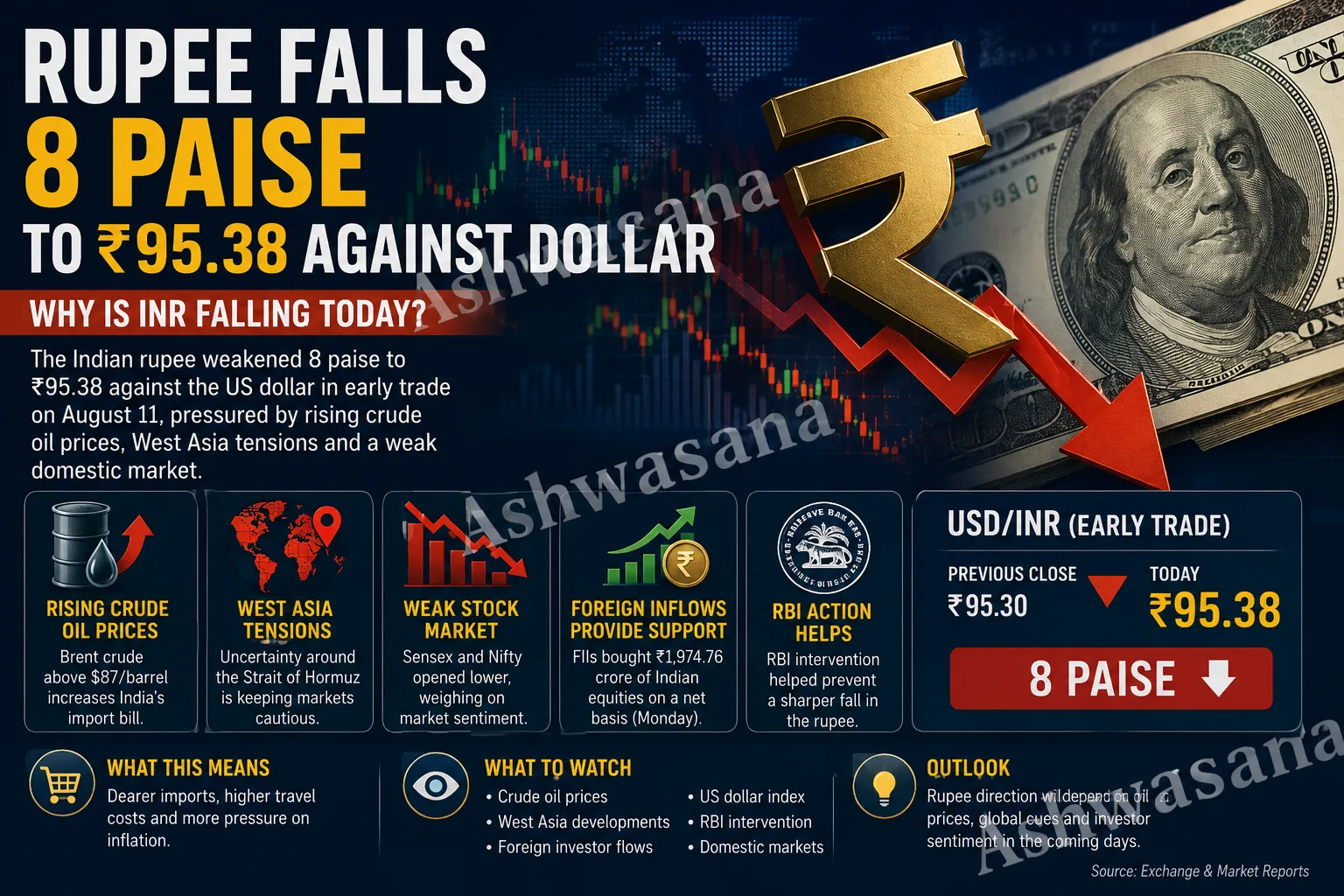
New Delhi: - The Indian rupee started Tuesday's trading session on a weaker note, falling 8 paise to ₹95.38 against the US dollar. The decline came as global markets remained cautious amid continuing tensions in West Asia and rising crude oil prices.
The rupee had closed at ₹95.30 against the dollar on Monday. On Tuesday, it opened at ₹95.38 and remained around that level during early trading.
While an 8-paise fall may appear small, the movement is important because the rupee is already trading at historically weak levels against the US currency. Traders are closely watching crude oil prices, foreign investment flows, the stock market and actions by the Reserve Bank of India (RBI) for further direction.
Rupee Today: INR Falls to ₹95.38 Against US Dollar
The rupee opened at ₹95.38 per US dollar on August 11, down from Monday's closing level of ₹95.30.
The latest movement comes at a time when global markets are facing uncertainty. Investors are keeping a close eye on developments in West Asia, particularly concerns surrounding the Strait of Hormuz.
The situation has also affected crude oil prices. Since India imports a large amount of its crude oil requirement, a rise in global oil prices can increase the country's import bill and create additional demand for US dollars.
That can put pressure on the Indian rupee.
Why Is the Rupee Falling Today?
There are several reasons behind the rupee's weakness.
1. Rising Crude Oil Prices
One of the biggest concerns for the Indian currency is the rise in crude oil prices.
Brent crude, the international benchmark, moved above the $87 per barrel mark. Higher oil prices are generally negative for the rupee because India is heavily dependent on crude oil imports.
When oil becomes more expensive, Indian importers need more dollars to pay overseas suppliers. This increases demand for the US currency and can weaken the rupee.
If crude prices remain high for a longer period, the impact can also spread to fuel prices, transportation costs and inflation.
2. West Asia Tensions
Ongoing uncertainty in West Asia is another major factor affecting the currency market.
Markets are particularly concerned about the situation around the Strait of Hormuz, one of the world's most important routes for oil shipments.
Any major disruption or prolonged uncertainty around this route could affect global oil supplies. That is why traders are watching developments in the region very closely.
Geopolitical uncertainty can also make investors more cautious. During periods of global stress, demand for the US dollar can increase because it is widely used as a safe-haven currency.
3. Weak Indian Stock Market
The domestic stock market also started Tuesday's session on a weak note.
The Sensex fell more than 320 points, while the Nifty declined by more than 94 points in early trade.
A weak stock market can put pressure on the rupee when foreign investors reduce their exposure to Indian assets. When investors move money out of Indian markets, demand for dollars can increase and demand for the rupee can fall.
However, foreign investors have not completely moved away from Indian equities. .
Foreign Investors Provide Some Support
Foreign institutional investors, or FIIs, remained active in the Indian stock market.
According to exchange data, foreign institutional investors bought Indian equities worth around ₹1,974.76 crore on a net basis on Monday.
Foreign investment inflows can support the rupee because investors need Indian currency when they invest in domestic shares and other assets.
This buying activity helped provide some balance against the negative impact of higher crude prices and weak market sentiment.
However, the impact of foreign inflows can change quickly depending on global market conditions.
RBI Action Helps Prevent a Sharper Fall
The Reserve Bank of India also remains an important factor in the foreign exchange market.
The RBI can intervene when it sees excessive volatility in the rupee. One method is to sell US dollars through banks, increasing the supply of dollars in the market.
Market participants said RBI intervention helped limit the rupee's decline during the previous trading session.
The central bank's objective is not necessarily to keep the rupee at one particular level. Instead, intervention can help reduce sudden and extreme movements in the currency market.
This support becomes particularly important when oil prices rise sharply or global investors become nervous.
What Does ₹95.38 Per Dollar Mean?
 rupee_against_dollar
For an ordinary person, the number ₹95.38 simply means that around ₹95.38 is required to buy one US dollar at the reported market rate.
But the rupee-dollar exchange rate affects many parts of the economy.
A weaker rupee can make imported products more expensive. Companies that buy crude oil, electronics, machinery, chemicals and other goods from overseas may have to spend more rupees.
The effect can eventually reach consumers if businesses pass higher import costs on through increased prices.
People travelling abroad may also feel the impact because foreign currency becomes more expensive in rupee terms.
Students paying tuition fees overseas and businesses making dollar payments can also face higher costs when the rupee weakens.
Is a Weak Rupee Always Bad?
Not necessarily.
A weaker rupee can create problems for importers, but it can benefit some exporters.
Indian companies that earn revenue in US dollars may receive more rupees when those dollars are converted into the domestic currency.
Export-oriented sectors can therefore benefit from a weaker rupee, depending on their costs and business structure.
However, the overall impact depends on the wider economic situation. If the rupee weakens because oil prices are rising sharply, the higher import bill can become a concern for the broader economy.
What Happens If the Rupee Falls Further?
A continued fall in the rupee could increase the cost of imports.
Crude oil is particularly important because India imports a large share of its oil needs. A weaker rupee combined with higher crude prices could put additional pressure on the country's import bill.
It could also affect inflation if higher input costs are passed on to consumers.
However, the rupee's movement will depend on several factors. A decline in crude oil prices, stronger foreign investment flows or a weaker US dollar could provide relief.
RBI intervention could also help reduce excessive volatility.
Rupee-Dollar Outlook: What Should Traders Watch?
Market participants are likely to focus on a few major factors in the coming sessions.
Crude oil prices will remain one of the most important indicators. A further rise in oil could increase pressure on the rupee.
West Asia developments will also remain important. Any improvement in the situation could reduce some of the risk premium in global markets.
Foreign investor flows are another key factor. Strong buying by overseas investors can support the Indian currency, while large outflows can increase pressure.
Traders will also watch the US dollar index, domestic equity markets and RBI intervention.
Rupee Falls 8 Paise: Key Points
- The rupee fell 8 paise to ₹95.38 against the US dollar in early trade.
- The currency had closed at ₹95.30 on Monday.
- Rising crude oil prices are putting pressure on the Indian currency.
- Brent crude moved above $87 per barrel amid global uncertainty.
- Continued West Asia tensions are keeping investors cautious.
- The Sensex and Nifty opened lower on Tuesday.
- Foreign institutional investors bought about ₹1,974.76 crore of Indian equities on Monday.
- RBI intervention has helped limit sharp movements in the rupee.
- A weaker rupee can increase the cost of imports but may benefit some exporters.
Conclusion
The Indian rupee fell 8 paise to ₹95.38 against the US dollar in early trade on Tuesday as rising crude oil prices and continuing geopolitical uncertainty weighed on market sentiment.
For now, the rupee is receiving some support from foreign investment inflows and RBI action. However, the direction of crude oil prices and developments in West Asia will remain important in determining where the currency goes next.
For consumers, businesses and investors, the rupee-dollar rate is more than just a financial-market number. Changes in the exchange rate can affect imports, overseas travel, education costs, fuel-related expenses and the earnings of export-oriented companies.
The next few trading sessions will therefore be closely watched for signs of whether the rupee can stabilise or faces further pressure against the US dollar.