AI Agents vs AI Chatbots: What’s the Difference and Which One Should You Use?
By Ashirbad ••Tech & AI• 107 views
Advertisement
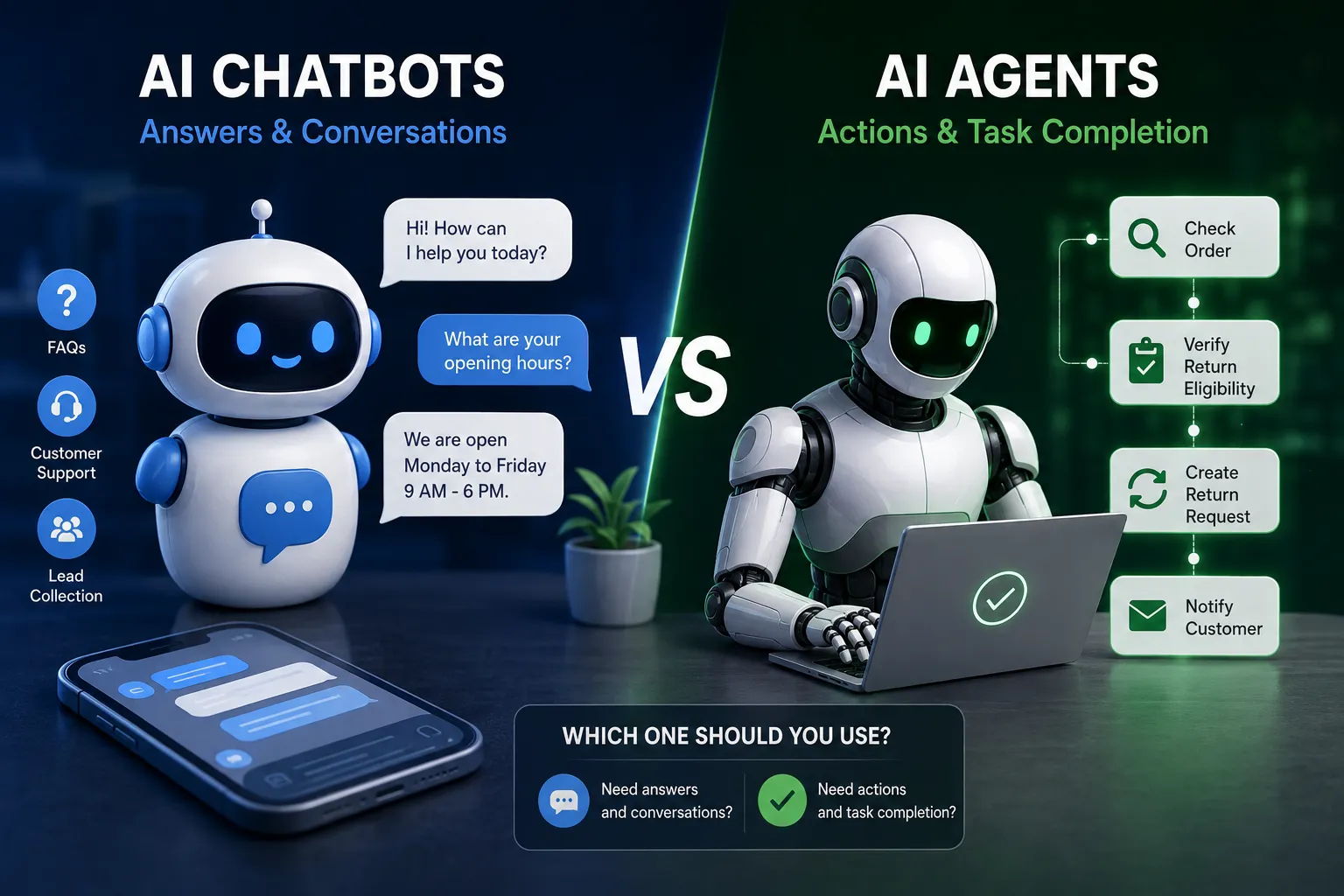
AI Agents vs. AI Chatbots: What's the Difference and Which One Should You Use?
Artificial intelligence is reshaping how people work, communicate, and manage everyday tasks. Two terms come up constantly in this shift: AI chatbots and AI agents.
They may sound similar, but they're built to do very different jobs.
A chatbot is designed around conversation. An AI agent goes further — it can reason through a goal, use tools, and work across multiple steps to actually complete a task.
So when it comes to AI agents vs. chatbots, which one is right for you? The answer depends entirely on what you're trying to accomplish.
What Is an AI Chatbot?
An AI chatbot is a software application built to communicate using natural language. Modern chatbots understand questions and generate responses using technologies like large language models (LLMs).
A typical business chatbot can answer things like:
- What are your opening hours?
- How much does this product cost?
- Where is my order?
- What's your return policy?
- How can I contact support?
Chatbots shine when customers ask the same handful of questions over and over. They provide instant, 24/7 answers and free up human employees from repetitive support work.
What Is an AI Agent?
An AI agent does more than respond — it acts.
AI agents understand a goal, plan the steps needed to reach it, use connected tools, and take real actions to complete a task. Modern agentic AI systems combine reasoning, planning, memory, and tool use to handle far more complex workflows than a chatbot ever could.
Here's a simple example: a customer wants to return a product.
A chatbot would explain the return policy and share a link to the returns page.
An AI agent could check the order, confirm it qualifies for a return, generate the return request, update internal systems, and notify the customer automatically — no human required.
A simple way to remember the distinction:
Chatbot = answers and conversation. AI agent = actions and task completion.
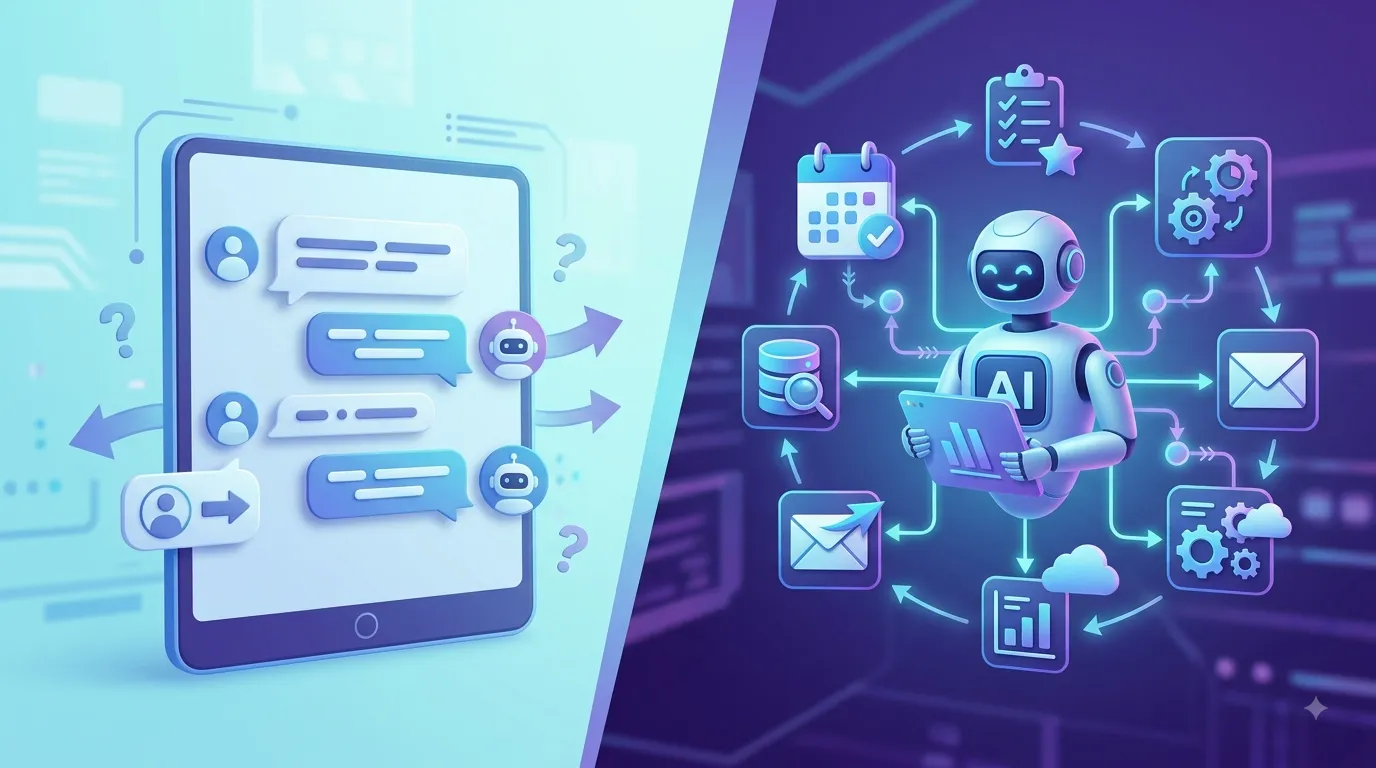
AI Agent vs. Chatbot: Key Differences
The core difference between an AI agent and a chatbot comes down to autonomy and action.
- Main purpose: Chatbots focus on conversation; agents focus on completing goals and tasks.
- Answering questions: Both can do this well.
- Taking action: Chatbots have limited ability; agents are built for it.
- Multi-step tasks: Chatbots struggle here; agents are designed for exactly this.
- Using external tools: Chatbots do this occasionally; agents do it routinely.
- Working across systems: Chatbots are usually confined to one; agents can operate across many.
- Autonomy: Chatbots have lower autonomy; agents have significantly higher autonomy.
- Best fit: Chatbots excel at FAQs and support; agents excel at automation and workflows.
Microsoft frames it simply: AI agents are systems that make decisions and take action toward specific goals, while chatbots exist primarily for conversation.
AI Chatbot Use Cases
There are plenty of situations where a chatbot is genuinely the better tool.
Customer support — Answering common questions about products, pricing, orders, and policies.
FAQ automation — Instantly resolving repetitive customer questions.
Website assistance — Helping visitors find information or navigate to the right page.
Lead collection — Capturing a visitor's name, email, and basic needs before routing them to sales.
Basic booking — Guiding customers through simple, linear booking flows.
For use cases like these, the added complexity of a full AI agent usually isn't necessary.
AI Agent Use Cases
AI agents earn their keep when a task involves multiple steps or spans different systems. Common AI agent use cases include:
- Customer service workflows
- Lead qualification
- Email management
- Appointment scheduling
- Research and data analysis
- Data processing
- Business reporting
- Order management
- Internal workflow automation
- Software and IT operations
Google Cloud describes AI agents as systems capable of pursuing goals and completing tasks through reasoning, planning, and memory. The exact capabilities always depend on how the agent is built, and which tools, data, and permissions it's given.
AI Agents vs. Chatbots for Business
For businesses, the decision should start with the actual problem you're solving — not the trend.
If your main need is answering customer questions, a chatbot may be all you need.
If your need is completing a process, an AI agent is likely the better fit.
A small online store might just need a chatbot to answer questions about shipping, pricing, and returns.
A growing online store might benefit from an AI agent that connects to business systems and handles order-related workflows with approved, automated actions.
That doesn't mean agents are always the superior choice. More capability means more complexity. AI agents often need access to company data, software tools, and internal systems — which makes security, permissions, testing, and human oversight essential considerations before deployment.
Which One Should You Use: AI Agents or Chatbots?
Choose an AI chatbot when:
- You mainly need to handle customer conversations
- Your customers ask the same questions repeatedly
- You want a simple, low-maintenance support tool
- You need FAQ automation
- You don't need the system to take complex actions
Choose an AI agent when:
- You need multi-step task automation
- The system has to interact with external tools
- Your workflow spans several applications
- You want AI working autonomously toward a specific goal
- You need more than basic Q&A support
In many cases, the smartest setup uses both: a chatbot handles the first conversation, then hands off to an AI agent when the request requires a more complex workflow.
Are AI Agents Better Than Chatbots?
Not necessarily — it depends entirely on your goal.
If you only need to answer common questions, building a full AI agent is often overkill. If you need AI to execute multi-step tasks across different systems, a basic chatbot won't cut it.
A useful rule of thumb:
Need an answer? Start with a chatbot. Need an action? Consider an AI agent.
This approach helps businesses avoid overpaying for capability they don't actually need.
The Future of AI Agents and Chatbots
The line between chatbots and AI agents is getting blurrier as platforms add more capability. Modern systems increasingly combine conversation, memory, tool use, and autonomous action in a single experience.
IBM notes that many AI agents now include chatbot-style interfaces — meaning conversation is just one layer of a much larger system.
In practice, this means businesses often won't have to choose one over the other. Conversational AI can serve as the front-end interface, while an agent works behind the scenes to actually get things done.
Frequently Asked Questions
Is ChatGPT a chatbot or an AI agent? On its own, ChatGPT functions primarily as a chatbot. When it's connected to tools, plugins, or external systems that let it take real actions, it starts to function more like an AI agent.
Can a chatbot be turned into an AI agent? Yes. Adding tool access, system integrations, and autonomous decision-making to a chatbot effectively upgrades it into an agent-like system.
Do AI agents replace chatbots? Not exactly. They solve different problems. Many businesses use both — a chatbot for front-line conversation, and an agent for the more complex work behind it.
Final Thoughts
The real difference in AI agents vs. chatbots comes down to what each is designed to accomplish.
An AI chatbot is built to communicate — answering questions and guiding users through conversation.
An AI agent is built to act — understanding a goal, planning the steps, and executing tasks to get it done.
Neither is automatically the better technology. For simple support and FAQs, a chatbot is often the more efficient, cost-effective solution. For complex workflows and business automation, an AI agent delivers far more value.
Before choosing either, identify the specific task you want to automate. Start with the simplest technology that solves the problem — and layer in more advanced capability only when you actually need it.
In short: chatbots talk. AI agents act.