AI Agents in 2026: How They Work & Free AI Tools
By Ashwasana••Tech & AI• 121 views
Advertisement
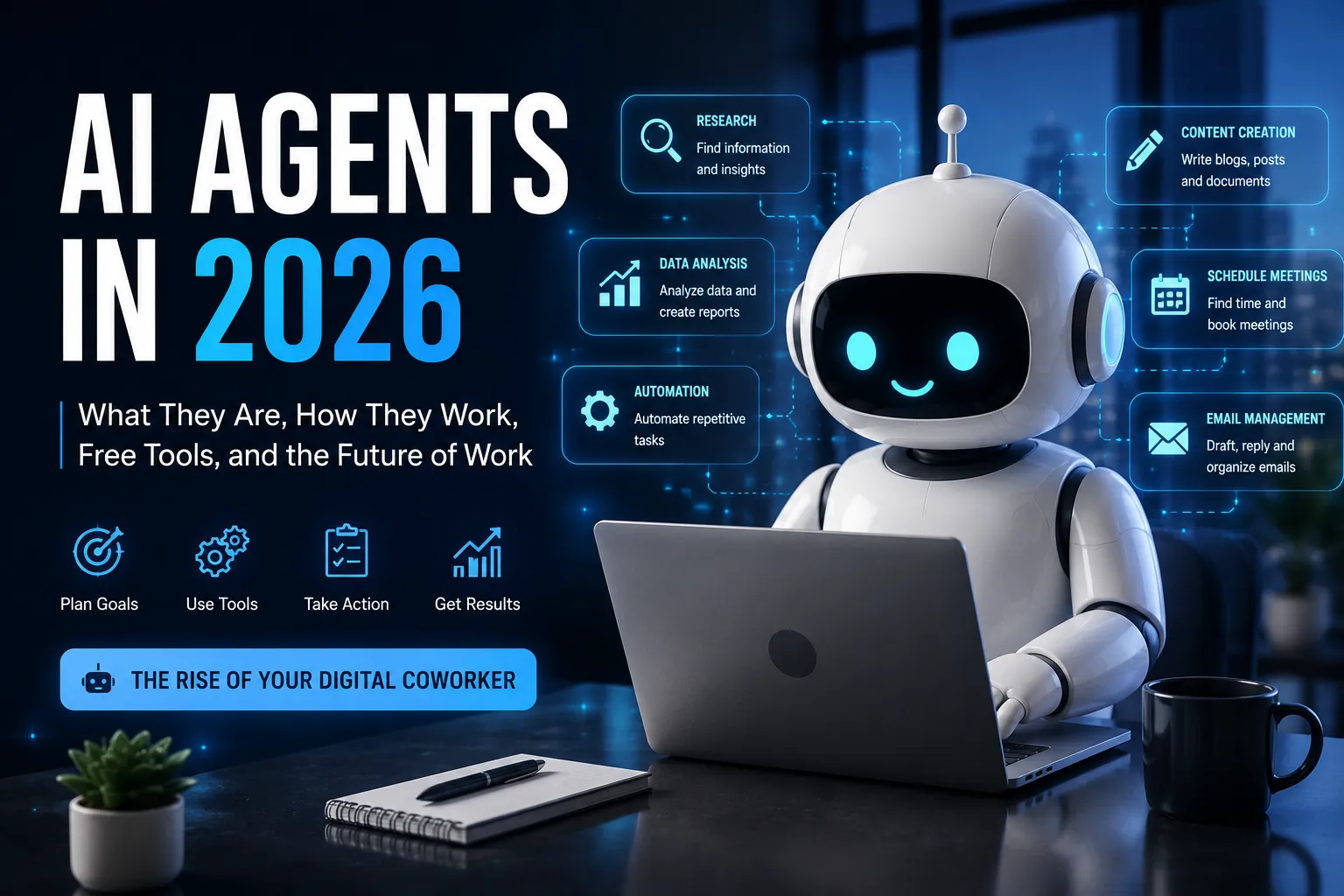
AI Agents in 2026: What They Are, How They Work, Free Tools, and the Future of Work
AI agents are changing the way we use artificial intelligence. Learn what AI agents are, how they work, what they can do, where to find free AI agents, and why they could transform the future of work.
For the past few years, artificial intelligence has primarily been something we talked to.
We asked AI to write emails, summarize documents, generate code, analyze data, create images, and answer questions.
But something fundamental is changing.
AI is increasingly moving from conversation to action.
Instead of simply telling you how to complete a task, a new generation of AI systems can take a goal, break it into smaller steps, use software and tools, evaluate results, and continue working until the task is completed.
These systems are known as AI agents.
And in 2026, AI agents are becoming one of the most interesting areas of artificial intelligence.
What Are AI Agents?
An AI agent is a software system that can understand a goal, reason about what needs to be done, use available tools, and take actions with some degree of autonomy.
A traditional chatbot generally follows a simple pattern:
You ask → AI responds.
An AI agent works more like:
You give it a goal → it plans → uses tools → takes actions → checks the results → adapts → completes the task.
For example, imagine telling an AI agent:
"Find five potential customers in the technology industry, research their companies, organize the information in a spreadsheet, and prepare personalized outreach emails."
A conventional chatbot might explain how you could do this yourself.
An AI agent could potentially perform much of the workflow itself.
That difference is important.
The AI is no longer just generating information.
It is participating in the workflow.
How Do AI Agents Work?
Although implementations vary, most AI agents combine several important capabilities.
1. Understanding the Goal
The agent first needs to understand what you want to accomplish.
For example:
"Prepare a weekly report about our website traffic."
The agent needs to interpret what "weekly report" means and determine what information is required.
2. Planning
The agent breaks the larger objective into smaller tasks.
For example:
- Collect website analytics.
- Compare this week's traffic with last week's.
- Identify the biggest changes.
- Find the most popular pages.
- Analyze traffic sources.
- Create a summary.
- Prepare the final report.
3. Using Tools
An agent becomes much more useful when it can interact with external tools.
Depending on its permissions, an agent might work with:
- Websites
- Databases
- APIs
- Spreadsheets
- Calendars
- Code execution environments
- Business software
- Search engines
- File systems
The AI model provides reasoning, while tools allow the agent to interact with the outside world.
4. Taking Action
After deciding what to do, the agent performs the required actions.
It might retrieve information from an API, update a spreadsheet, create a document, send a notification, or execute code.
5. Checking the Result
A more advanced agent doesn't simply perform an action and stop.
It can evaluate the result.
If something went wrong, it may attempt another approach.
This creates a loop:
Plan → Act → Observe → Evaluate → Adjust → Act again
That feedback loop is one of the key ideas behind autonomous AI agents.
AI Agents vs Chatbots: What's the Difference?
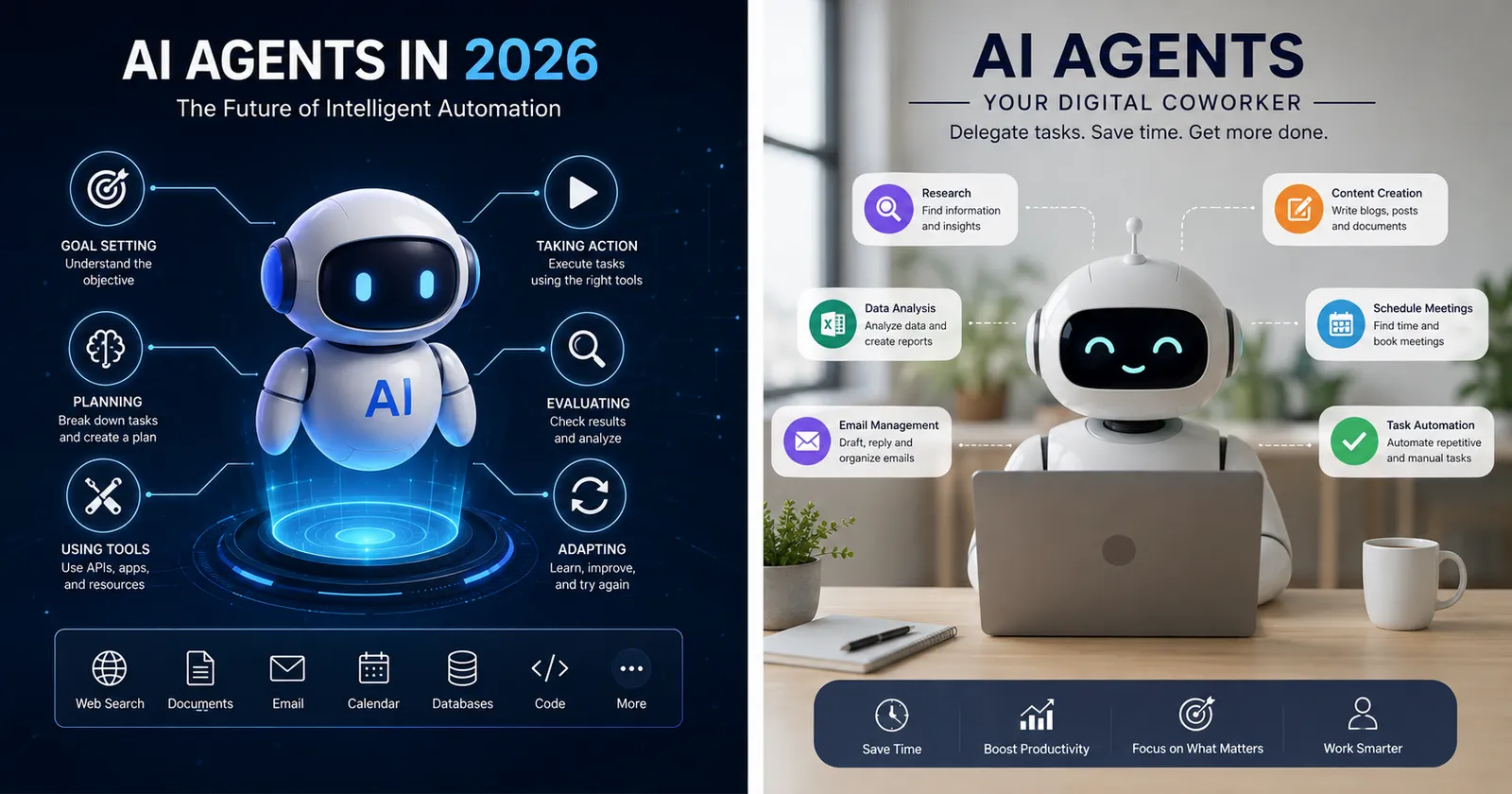
The terms "AI chatbot" and "AI agent" are sometimes used interchangeably, but they describe different levels of capability.
| Feature | AI Chatbot | AI Agent |
| Generates content | Yes | Yes |
| Uses external tools | Sometimes | Often |
| Creates a plan | Limited | Yes |
| Executes multiple steps | Limited | Yes |
| Takes actions | Limited | Yes |
| Works autonomously | Usually limited | More capable |
| Adapts based on results | Limited | Yes |
A chatbot primarily helps you think and communicate.
An agent can increasingly help you execute.
Why Are AI Agents Becoming Important?
The biggest reason is simple:
Knowledge work contains a huge number of repetitive tasks.
Employees spend time searching for information, moving data between applications, preparing reports, responding to messages, scheduling meetings, updating records, checking documents, and performing other routine activities.
Many of these tasks don't necessarily require a human to perform every individual step.
AI agents could automate portions of these workflows.
Instead of replacing an entire job, an agent may first replace or simplify individual tasks within a job.
The future of AI at work may not simply be:
Human vs AI
It may increasingly become:
Human + AI agent
Free AI Agents: Can You Use AI Agents for Free?
One of the most common questions people have is whether AI agents are free.
The answer is: some are, but it depends on the platform, model, features, and usage limits.
Some AI agent platforms and open-source projects may offer free tiers, free trials, or software that can be run locally.
However, "free" doesn't always mean unlimited.
A free AI agent may have limitations such as:
- Daily usage limits
- Limited model access
- Fewer automation runs
- Restricted integrations
- Limited memory
- Lower processing limits
- Fewer advanced features
Before choosing a free AI agent, check what is actually included in the free plan.
What Can Free AI Agents Do?
Depending on the platform, free AI agents can potentially help with tasks such as:
- Research
- Writing
- Brainstorming
- Data analysis
- Coding
- Content creation
- Summarization
- Web research
- Simple automation
- Personal productivity
For someone experimenting with AI agents for the first time, a free option can be a good way to understand how agent-based workflows operate before paying for advanced features.
Free AI Agents vs Paid AI Agents
The main difference is usually not whether the technology works at all, but how much you can use it and what capabilities are available.
| Feature | Free AI Agents | AI Agents |
| Usage limits | Usually | Higher |
| Advanced models | Sometimes limited | More options |
| Integrations | Limited on some platforms | Usually more |
| Automation | Often limited | More extensive |
| Support | Basic or community | Often better |
| Enterprise features | Rare | Common |
If you're just learning about AI agents, starting with a free option can make sense.
Real-World AI Agent Use Cases
AI agents can potentially be used across many industries.
1. Customer Support
A customer-support agent could:
- Understand customer questions
- Search a knowledge base
- Check an order
- Identify the customer's problem
- Recommend a solution
- Update a support ticket
- Escalate complex cases to a human
Instead of simply answering a question, the system can participate in the entire support workflow.
2. Software Development
AI coding agents can assist developers by:
- Understanding a feature request
- Inspecting an existing codebase
- Writing code
- Running tests
- Identifying errors
- Fixing problems
- Creating documentation
The developer remains responsible for reviewing the result, but repetitive work can potentially be reduced.
3. Marketing
Marketing teams could use agents to:
- Research competitors
- Analyze customer feedback
- Generate campaign ideas
- Draft content
- Analyze performance data
- Prepare reports
4. Research
Research agents can help gather information from multiple sources, organize findings, compare information, and produce structured summaries.
Human verification remains important, especially when accuracy and source quality matter.
5. Business Operations
Companies can use AI agents to automate repetitive operational workflows.
For example:
New customer → collect information → verify details → update CRM → notify team → create follow-up task
A workflow that previously required several manual actions could potentially be coordinated by an AI-powered system.
AI Agents Are Becoming Digital Coworkers
Perhaps the most interesting way to think about AI agents is as digital coworkers.
Not coworkers in the human sense.
Rather, software systems that can be assigned goals and responsibilities.
Imagine starting your workday and telling an AI agent:
"Review yesterday's sales data and identify anything unusual."
Later, it could return:
- Revenue increased.
- Traffic from one campaign dropped.
- Several products had unusual changes.
- A customer segment showed higher engagement.
You could then ask:
"Investigate the campaign problem."
The agent could continue working on the next task.
This creates a different relationship with software.
Instead of navigating dozens of interfaces and manually performing every action, users increasingly communicate with software through goals and instructions.
What Are the Benefits of AI Agents?
Increased Productivity
Agents can automate repetitive workflows and allow people to focus on higher-value tasks.
Faster Execution
Tasks that previously required multiple manual steps can potentially be completed much faster.
24/7 Availability
Software agents don't need traditional working hours. They can potentially monitor systems and perform tasks continuously.
Scalability
Companies may be able to automate workflows without increasing manual effort at the same rate as their growth.
Personalization
AI agents can potentially adapt workflows to individual users, customers, or business requirements.
What Are the Risks of AI Agents?
The excitement around AI agents should not hide their limitations.
AI systems can make mistakes.
They can misunderstand instructions, use incorrect information, fail to recognize unusual situations, or make poor decisions.
This becomes particularly important when agents are given access to sensitive systems.
Imagine an agent with permission to:
- Send emails
- Modify databases
- Purchase products
- Change financial records
- Delete files
A mistake could have real consequences.
That's why responsible AI agent systems need safeguards such as:
- Permission controls
- Human approval
- Monitoring
- Audit logs
- Restricted tool access
- Clear task boundaries
- Error handling
- Security controls
The more autonomy an AI receives, the more important these safeguards become.
Will AI Agents Replace Jobs?
This is one of the biggest questions surrounding the technology.
The answer is unlikely to be as simple as yes or no.
AI agents may automate tasks rather than eliminate every part of a profession.
A marketing professional may spend less time manually collecting data and more time deciding what to do with the information.
A developer may spend less time writing repetitive code and more time designing systems.
A customer-support employee may handle fewer routine questions and focus more heavily on difficult customer problems.
The more useful question may therefore be:
Which tasks will AI agents automate, and which human skills will become more valuable because of AI?
What Skills Will Matter in an AI-Powered Workplace?
As AI becomes better at executing routine tasks, human skills may become even more important.
Critical Thinking
People need to evaluate whether an AI-generated result actually makes sense.
Problem Solving
Humans still need to define the right problems and decide what outcomes matter.
Communication
Clear instructions become increasingly valuable when working with AI systems.
Creativity
Generating ideas is only one part of creativity. Selecting, combining, and improving ideas remains important.
Domain Expertise
Someone who understands a field can often recognize mistakes that an AI system cannot.
AI Literacy
Knowing how to use AI tools effectively will increasingly become a practical workplace skill.
The Future of AI Agents
The technology is still developing rapidly.
Future AI agents may become better at understanding context, planning complex tasks, using multiple tools, remembering relevant information, and operating reliably over longer periods.
This could lead to a world where people don't interact with every piece of software directly.
Instead, they may increasingly communicate with an AI agent that coordinates those tools on their behalf.
Think about the difference between:
"Open my calendar."
and:
"Find a good time for a meeting with the design team next week, considering everyone's availability."
The second request isn't really about opening a calendar.
It's about delegating a goal.
That shift—from software as something we operate to software as something we delegate to—could become one of the defining changes of the next generation of computing.
Frequently Asked Questions
What are AI agents?
AI agents are software systems that can understand goals, plan tasks, use tools, and perform actions with varying levels of autonomy.
Are AI agents free?
Some AI agent platforms offer free plans, free trials, or open-source options. However, free versions commonly have usage or feature limitations.
What are the best free AI agents?
The best option depends on what you want to accomplish. Different AI agents are designed for research, coding, automation, productivity, business operations, and other tasks.
What is the difference between AI agents and chatbots?
Chatbots primarily focus on conversation and generating responses, while AI agents can be designed to plan and execute multi-step tasks using external tools.
Can AI agents work without humans?
Some agents can perform tasks with significant autonomy, but many real-world systems still require human supervision, approvals, or predefined limits.
What can AI agents be used for?
AI agents can help with customer support, software development, research, marketing, data analysis, business operations, scheduling, automation, and productivity.
Will AI agents replace humans?
AI agents are more likely to automate many individual tasks and change how jobs are performed than simply eliminate every job.
Are AI agents safe?
AI agents can be useful, but their safety depends on how they are designed, what permissions they receive, what data they can access, and how their actions are monitored.
Final Thoughts
AI is entering a new phase.
The first major wave of generative AI taught computers to create.
The next wave is teaching them to act.
AI agents could become an important bridge between artificial intelligence and the software people use every day. Instead of simply generating an answer, an AI system can increasingly be asked to pursue a goal, use tools, and complete a workflow.
Free AI agents are also making it easier for people to experiment with this technology without immediately committing to expensive software.
But the most important development isn't simply that AI is becoming more powerful.
It's that our relationship with software is changing.
Instead of telling computers exactly what buttons to press, we may increasingly tell AI systems what we want to accomplish.
The future of AI may not just be about better answers. It may be about getting things done.