150 Years of Vande Mataram: Iconic National Song to Be Sung at Red Fort on Independence Day 2026
By Ashwasana••News & Events• 115 views
Advertisement
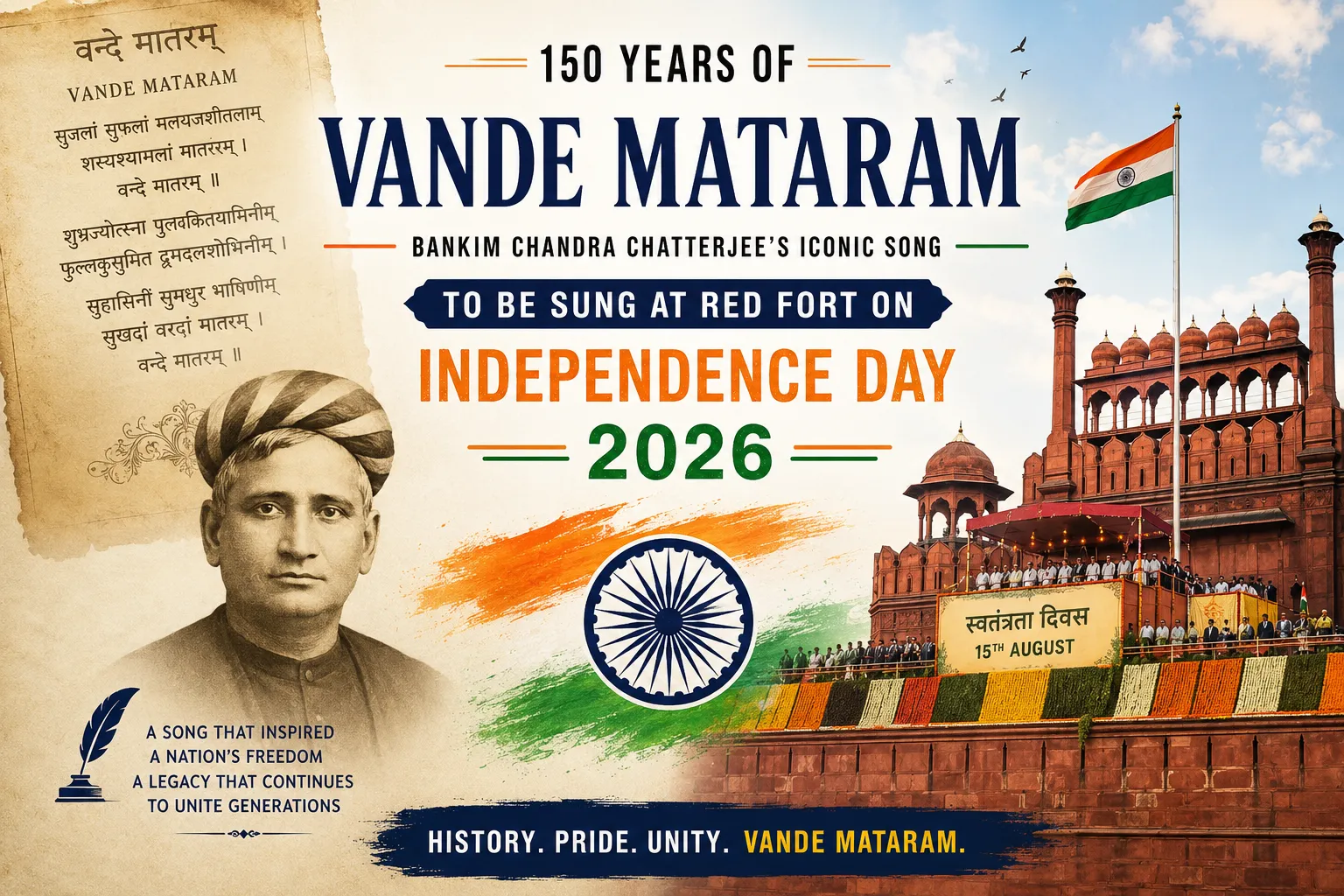
150 Years of ‘Vande Mataram’: Iconic National Song to Be Sung at Red Fort on Independence Day 2026....!
India is set to mark a historic moment this Independence Day as ‘Vande Mataram’ will be sung from the ramparts of the Red Fort for the first time. The special performance comes as the country commemorates 150 years of Bankim Chandra Chatterjee’s famous patriotic composition.
India’s Independence Day celebrations at the Red Fort are known for their powerful symbols of freedom and national pride. This year, the ceremony will carry an additional historical significance with ‘Vande Mataram’ being sung at the Red Fort on August 15, 2026.
The song, written by Bengali writer and poet Bankim Chandra Chatterjee, has been closely associated with India’s freedom movement for generations. Its inclusion in the main Independence Day ceremony comes during a year-long national commemoration marking 150 years of the song.
‘Vande Mataram’ at the Red Fort: What Is Special This Year?
For the first time, ‘Vande Mataram’ is scheduled to be sung from the ramparts of the Red Fort during the Independence Day celebrations.
The song is expected to be presented before the national anthem as part of this year's official programme. The 2026 Independence Day celebrations will also highlight the role and energy of India's younger generation, with ‘Yuva Shakti’ being an important theme of the event.
The decision gives a new setting to a song that once travelled through public meetings, political gatherings and the streets of the freedom movement.
The Red Fort itself has a special connection with India's Independence Day. Every year, the Prime Minister addresses the nation from its historic ramparts. Bringing ‘Vande Mataram’ into this ceremony therefore adds another layer of historical meaning.
How Old Is ‘Vande Mataram’?
The roots of ‘Vande Mataram’ go back to 1875, when Bankim Chandra Chatterjee composed the song.
The Government of India identifies November 7, 1875, as the date associated with its composition. The song later appeared in Bankim Chandra's famous novel Anandamath, which was published in 1882.
This means 2025 marked 150 years since the composition of the song. The government launched a year-long commemoration running from November 7, 2025, to November 7, 2026, with programmes being organised across the country.
So, the 2026 Independence Day ceremony comes during this larger 150-year commemoration.
Why Did ‘Vande Mataram’ Become So Important?
The words ‘Vande Mataram’ express respect and devotion towards the motherland India .
But the importance of the song goes beyond its meaning. During the freedom struggle, it became a powerful expression of India's growing desire for independence.
People used the song at meetings and public gatherings, and it gradually became associated with the national movement against British rule. Its message of love for the motherland helped create a sense of unity among people participating in the freedom struggle. The Ministry of Culture describes it as an important symbol of the collective spirit of India's independence movement.
The song's journey also shows how literature and music became important tools during India's struggle for freedom.
When Was ‘Vande Mataram’ First Sung Publicly?
One of the important moments in the song's history came in 1896, when Rabindranath Tagore sang ‘Vande Mataram’ at the Indian National Congress session.
That public performance helped the song reach a wider political audience and strengthened its association with the freedom movement.
Over the years, ‘Vande Mataram’ became one of the best-known patriotic songs in India.
‘Vande Mataram’ and Its Status as the National Song
‘Vande Mataram’ and ‘Jana Gana Mana’ have different official statuses.
India's national anthem is ‘Jana Gana Mana’, while ‘Vande Mataram’ is recognised as the National Song of India.
On January 24, 1950, the Constituent Assembly gave official recognition to ‘Vande Mataram’ as the National Song. The first two stanzas are the portion traditionally recognised in this official context.
This distinction is important because the two songs hold different constitutional and ceremonial positions, even though both have a deeply respected place in India's national life.
150 Years Later, Why Does the Song Still Matter?
A century and a half after it was written, ‘Vande Mataram’ continues to appear in national celebrations, cultural programmes and public events.
The 150-year commemoration launched by the government is not limited to one ceremony. It includes activities intended to introduce younger generations to the history and meaning of the song. The Ministry of Culture says the initiative aims to connect students and young people with its message of unity and courage.
The song was also highlighted during the 2026 Republic Day celebrations, where a tableau presented its history and role in India's freedom movement.
This shows that the 150th anniversary is being treated as an opportunity to revisit the song's journey rather than simply mark a date.
What the Red Fort Performance Represents
The first performance of ‘Vande Mataram’ at the Red Fort during Independence Day celebrations is significant because of the location and the history behind the song.
The Red Fort has been the centre of India's Independence Day ceremony for decades. ‘Vande Mataram’, meanwhile, represents an earlier chapter of the freedom struggle — a time when patriotic literature, songs and public gatherings helped build the spirit of resistance.
Bringing the two together on August 15, 2026, creates a link between India's freedom struggle, the country's independence and its present-day national identity.
A Song That Connected Generations
The story of ‘Vande Mataram’ is not simply the story of an old patriotic song.
It began as a literary composition by Bankim Chandra Chatterjee, became associated with the freedom movement, was sung at important national gatherings and was later recognised as India's National Song.
Now, 150 years after its creation, it is preparing to be heard from one of the most important national landmarks in the country.
As Indians gather at the Red Fort for Independence Day 2026, the rendition of ‘Vande Mataram’ will serve as a reminder of the history behind the freedom that the country celebrates every August 15.
From the pages of 19th-century literature to the ramparts of the Red Fort, ‘Vande Mataram’ has travelled a remarkable journey — and its place in India's national story continues even after 150 years.
Short Description
‘Vande Mataram’ will be sung from the Red Fort for the first time during India's Independence Day celebrations on August 15, 2026. Here is the story of Bankim Chandra Chatterjee’s iconic song, its 150-year journey and its role in India's freedom movement.
FAQ Schema Questions
You can also add these FAQs at the bottom of the article for SEO:
Q1. When was Vande Mataram written?
Vande Mataram was composed by Bankim Chandra Chatterjee in 1875.
Q2. Who wrote Vande Mataram?
Vande Mataram was written by Bengali writer and novelist Bankim Chandra Chatterjee.
Q3. When will Vande Mataram be sung at the Red Fort?
It is scheduled to be sung during the Independence Day celebrations at the Red Fort on August 15, 2026.
Q4. Why is 2026 important for Vande Mataram?
The year falls within the national commemoration of 150 years of Vande Mataram, which began in November 2025.
Q5. Is Vande Mataram India's National Anthem?
No. Jana Gana Mana is India's National Anthem, while Vande Mataram is recognised as India's National Song.
Q6. Who composed Vande Mataram?
The song was written by Bankim Chandra Chatterjee.
Conclusion
The 150-year journey of ‘Vande Mataram’ is more than the history of a patriotic song. From Bankim Chandra Chatterjee’s words in the 19th century to its role in India’s freedom movement and its recognition as the National Song, it has remained a powerful symbol of love for the motherland.
Its scheduled rendition at the Red Fort on Independence Day 2026 gives this historic song a special place in the celebrations. As India marks another year of independence, the occasion will also remind younger generations of the sacrifices, emotions and spirit that shaped the country’s freedom struggle.
After 150 years, ‘Vande Mataram’ continues to connect India’s past with its present — carrying a message of patriotism, unity and pride from one generation to the next.